


Page 13 - ENT IMPLANTS CATALOGUE IMPLANTS ORL
P. 13
IMPLANT MATERIALS AND

             PROCESSING


             UTMOST CARE AND HIGHEST PRECISION                     TITANIUM
             In order to achieve best possible results, the elegant design of the   KURZ uses only high-quality  (ASTM F67, medical grade), pure ti-
             KURZ prostheses often probes the limits of feasibility. The manufac-  tanium for its prostheses. The properties of this material grade are
             turing process of these prostheses requires highest precision and ut-  ideally suited due to its rigidity, weight and technical manufacturing
             most care. Stringent inspections furthermore ensure compliance with   possibilities. The biocompatibility of this metal is also suitable for
             highest quality standards.                            long-term applications.

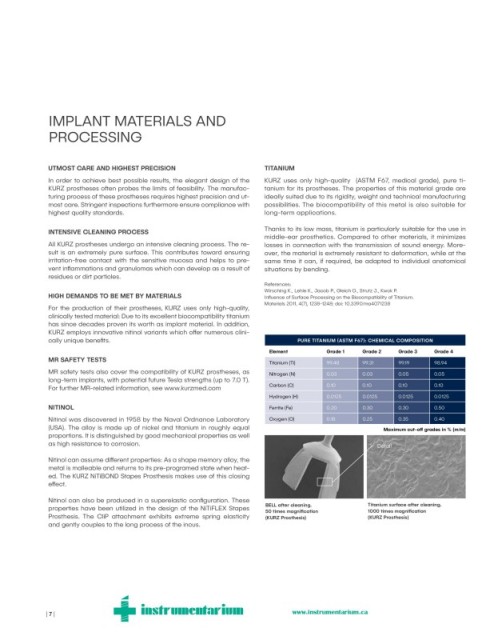
             INTENSIVE CLEANING PROCESS                            Thanks to its low mass, titanium is particularly suitable for the use in
                                                                   middle-ear prosthetics. Compared to other materials, it minimizes
             All KURZ prostheses undergo an intensive cleaning process. The re-  losses in connection with the transmission of sound energy. More-
             sult is an extremely pure surface. This contributes toward ensuring   over, the material is extremely resistant to deformation, while at the
             irritation-free contact with the sensitive mucosa and helps to pre-  same time it can, if required, be adapted to individual anatomical
             vent inflammations and granulomas which can develop as a result of     situations by bending.
             residues or dirt particles.
                                                                   References:
                                                                   Wirsching K., Lehle K., Jacob P., Gleich O., Strutz J., Kwok P.
             HIGH DEMANDS TO BE MET BY MATERIALS                   Influence of Surface Processing on the Biocompatibility of Titanium.
                                                                   Materials 2011, 4(7), 1238-1248; doi: 10.3390/ma4071238
             For the production of their prostheses, KURZ uses only high-quality,
             clinically tested material: Due to its excellent biocompatibility titanium
             has since decades proven its worth as implant material. In addition,
             KURZ employs innovative nitinol variants which offer numerous clini-
             cally unique benefits.                                        PURE TITANIUM (ASTM F67): CHEMICAL COMPOSITION
                                                                    Element       Grade 1  Grade 2  Grade 3  Grade 4
             MR SAFETY TESTS                                        Titanium (Ti)   99.48   99.31   99.19    98.94
             MR safety tests also cover the compatibility of KURZ prostheses, as   Nitrogen (N)   0.03   0.03   0.05   0.05
             long-term implants, with potential future Tesla strengths (up to 7.0 T).
             For further MR-related information, see www.kurzmed.com  Carbon (C)   0.10    0.10     0.10     0.10
                                                                    Hydrogen (H)   0.0125   0.0125   0.0125   0.0125
             NITINOL                                                Ferrite (Fe)   0.20    0.30     0.30     0.50
             Nitinol was discovered in 1958 by the Naval Ordnance Laboratory     Oxygen (O)   0.18   0.25   0.35   0.40
             (USA). The alloy is made up of nickel and titanium in roughly equal                Maximum cut-off grades in % (m/m)
             proportions. It is distinguished by good mechanical properties as well
             as high resistance to corrosion.                                                  Detail
             Nitinol can assume different properties: As a shape memory alloy, the
             metal is malleable and returns to its pre-programed state when heat-
             ed. The KURZ NiTiBOND Stapes Prosthesis makes use of this closing
             effect.

             Nitinol can also be produced in a superelastic configuration. These
             properties have been utilized in the design of the NiTiFLEX Stapes   BELL after cleaning.  Titanium surface after cleaning.
                                                                   50 times magnification
                                                                                            1000 times magnification
             Prosthesis. The CliP attachment exhibits extreme spring elasticity   (KURZ Prosthesis)   (KURZ Prosthesis)
             and gently couples to the long process of the incus.


            | 7 |                                                        www.instrumentarium.ca

